
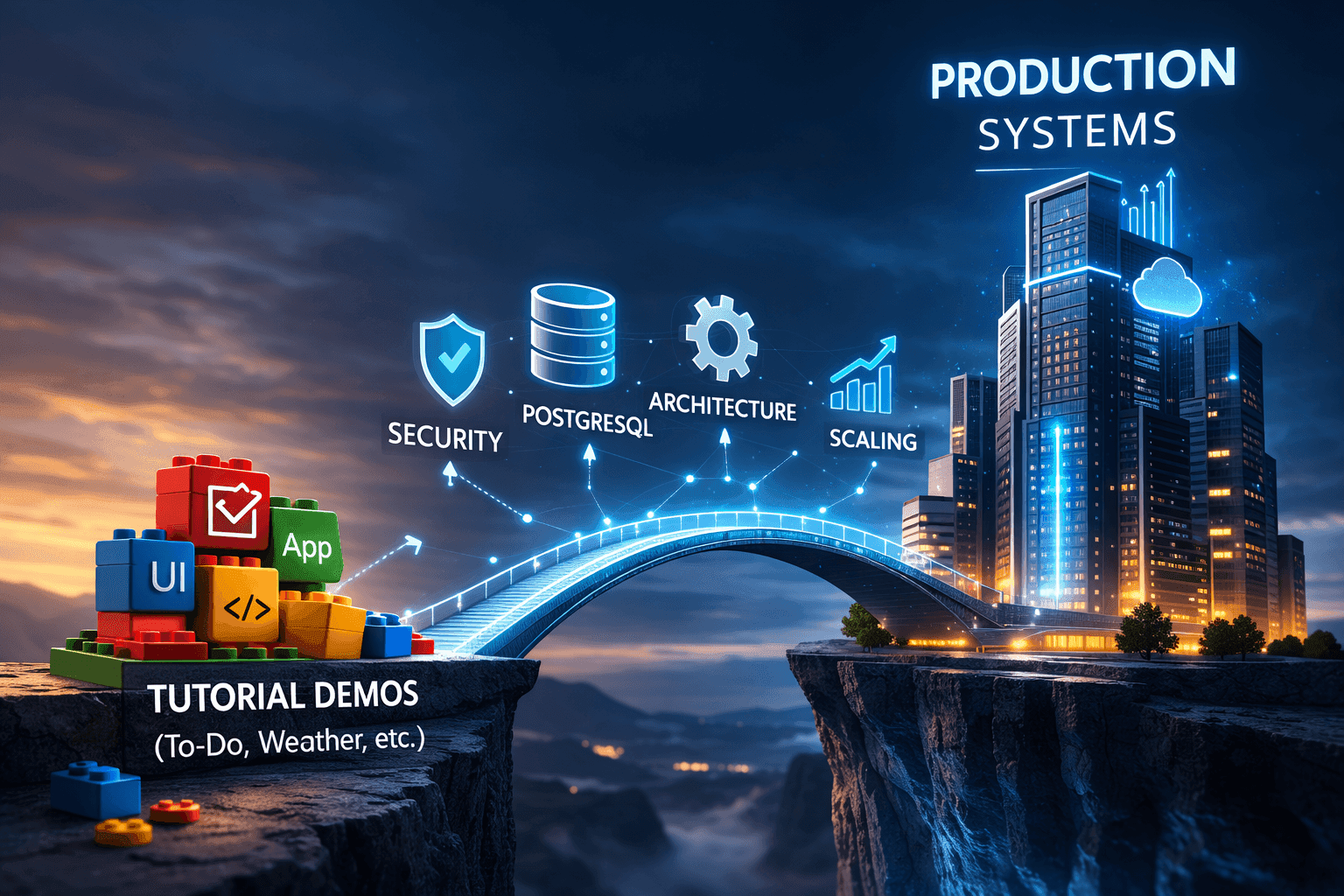
Almost everyone online can tell you which stack to learn. You will hear advice like:
- “Learn MERN.”
- “Use Next.js.”
- “Build some projects and deploy them.”
But if you look closely, most of these tutorials lead to demo projects that have little connection with how real production systems are built.
That’s the gap many developers eventually notice.
They know how to build a UI.
They know how to connect a database.
They know how to deploy a small project.
Yet when it comes to real-world development, things suddenly feel different.
This article is about bridging that gap.
If you are serious about becoming a modern developer, these are the areas you should pay attention to.
First, Think Like a Business Owner
Before choosing a stack, pause for a moment and think from a different perspective.
Why do companies build websites?
A website is not just something that says:
“We exist online.”
In reality, a website is part of a company’s sales and marketing infrastructure.
It helps businesses:
- attract customers
- generate leads
- process payments
- manage users
- automate workflows
That means when you build a website, you are often building a small digital system that supports real business operations. And that requires a different mindset than simply building landing pages.
Next.js: What Should You Actually Learn?
Today, many developers recommend Next.js, and for good reason.
It offers:
- strong SEO support
- excellent performance
- flexible rendering strategies
- a mature React ecosystem
But simply learning the framework API is not enough.
If you want to build real projects, you need to understand how Next.js is used in production.
Focus on learning these areas:
- routing structure and project architecture
- server-side rendering (SSR)
- static site generation (SSG)
- incremental static regeneration (ISR)
- API communication patterns
- SEO configuration (metadata, sitemap, robots)
Understanding architecture like this makes your project much easier to maintain as it grows.
APIs: Anyone Can Create Them — But Can You Secure Them?
Creating an API endpoint is easy. But in production, APIs must do much more than return data.
They must be secure, predictable, and scalable.
Important concepts developers must understand include:
- request validation
- rate limiting
- authentication checks
- authorization rules
- proper error responses
For example:
if (!session) {
  return Response.json({ error: "Unauthorized" }, { status: 401 })
}
This works as a basic guard, but real production APIs usually require several additional security layers.
In production systems, developers often implement:
- token validation (JWT or session tokens)
- role-based access control
- request rate limiting
- input validation
- logging and monitoring
These measures help prevent common problems such as:
- unauthorized access
- brute-force attacks
- token abuse
- API scraping
What Real Production APIs Usually Combine
In practice, production APIs often combine multiple protections:
| Security Layer | Purpose |
|---|---|
| Authentication | Verify user identity |
| Authorization | Control access levels |
| Rate limiting | Prevent abuse |
| Input validation | Protect against malformed requests |
| Logging | Track suspicious activity |
Building secure APIs is not about a single check — it’s about multiple layers working together.
These small details make a huge difference in real production environments.
Authentication: Beyond the “Quick Tutorial” Approach
A common pattern in courses or YouTube videos is:
- install an auth library
- connect Google login
- finish the project
While third-party authentication services can be useful, real applications require deeper understanding.
Developers should know:
- when to use OAuth
- how session management works
- how password hashing works
- how to protect authentication routes
- how to prevent token abuse
Example
import bcrypt from "bcrypt"

const hashedPassword = await bcrypt.hash(password, 12)
Password security is not only something you handle inside APIs.
It is also an important part of data modeling and storage design.
It involves:
- secure hashing
- proper database storage
- safe verification during login
Databases: Why SQL Still Matters
Many beginner projects use tools like:
- Firebase
- MongoDB
These are useful for quick prototypes.
However, when you look at production systems, most companies rely heavily on SQL databases, especially PostgreSQL.
Why?
Because relational databases are excellent for:
- structured data
- transactional systems
- financial operations
- complex queries
Instead of managing your own database server, modern developers often use managed database services.
Popular options include:
| Platform | Type |
|---|---|
| Supabase | Managed PostgreSQL |
| Neon | Serverless PostgreSQL |
| PlanetScale | Serverless MySQL |
| AWS RDS | Managed PostgreSQL / MySQL |
In practice, both PostgreSQL and MySQL are excellent choices.
The most important thing is learning relational database design and data modeling, not just the database brand.
Why Frontend and Backend Should Be Separate
Another concept rarely explained in beginner tutorials is separation of services. Many simple projects combine everything into one application. But real production systems often separate responsibilities.
Why does this matter?
- scale independently
- improve security
- simplify maintenance
- support multiple clients (web, mobile, etc.)
This separation becomes increasingly important as applications grow.
The Skills That Actually Matter
Many tutorials focus on frameworks. But real-world development depends more on understanding systems. Developers who grow quickly usually focus on learning:
- architecture thinking
- API design
- database modeling
- authentication security
- infrastructure basics
Frameworks will change every few years.
But developers who understand systems, architecture, and data will stay valuable for decades.
The Truth Most Tutorials Skip
Most tutorials show how to build something quickly. Few explain how systems behave after launch. Once a project goes live, new challenges appear:
- performance issues
- security concerns
- scaling traffic
- maintaining data consistency
That’s why learning modern development should always go beyond demos.
A Better Way to Think About Learning
Instead of asking:
“Which stack should I learn?”
Try asking:
“How do real production systems actually work?”
That question changes everything.
Once you understand how systems connect together - frontend, backend, database, and infrastructure - building modern applications becomes much clearer.
And that is the difference between learning tools and learning how real software works.
Read more

Why AI Won't Save Developers From Learning Payment Integration
AI can write frontend components, but big companies still won't trust it with money. Learn the basics of payment integration from Stripe to webhooks and why this skill keeps developers employed.

10 Powerful Chrome Extensions for SEO in 2026 - Tools Every Marketer and Developer Should Know
Looking for powerful SEO tools for Chrome? Discover the best Chrome extensions for SEO analysis, keyword research, technical audits, and competitor tracking - handpicked for 2026.

Next.js Sitemap Guide 2026: Fix Indexing Issues & Build Scalable SEO Architecture
Google discovers your sitemap but pages stay 'Discovered - currently not indexed'. Learn how to implement paginated sitemaps with Next.js for large sites.