

The AI Agent Revolution Is Moving Faster Than Ever
The past 48 hours have brought another wave of major announcements in the artificial intelligence space. Anyone trying to keep up with models, agents, and infrastructure updates knows the feeling, something new drops every time you close your browser.
OpenAI Releases GPT-5.5 With Agent Capabilities
OpenAI has officially released GPT-5.5, marking a major strategic shift from conversational AI to agent-driven execution. The model series codenamed "Spud" is not just an incremental update. It represents a fundamental repositioning of how OpenAI expects people to interact with its technology. The company is framing GPT-5.5 as a "new class of intelligence for real work and powering agents," moving well beyond the chat interface that defined earlier versions.
The new model comes in three variants: the base GPT-5.5 model, GPT-5.5 Thinking for more structured reasoning, and GPT-5.5 Pro for high-precision demanding tasks.
On the coding side, the improvements are substantial. GPT-5.5 achieved 82.7 percent on the Terminal-Bench 2.0 benchmark, which tests command-line workflows, outperforming both Anthropic and Google's latest offerings. It also scored 73.1 percent on SWE-Bench Pro, OpenAI's internal evaluation for long-horizon coding tasks.
The platform now offers a 400,000 token context window and what the company describes as autonomous multi-step planning capabilities that let the model extract goals from complex tasks, create execution plans, use tools independently, and self-correct until the job is finished.
Google Launches Gemini 2.5 Pro With Large Context Window
Right on the heels of OpenAI, Google has made its own move with the surprise release of Gemini 2.5 Pro. this release achieved a 63.8 percent score on the SWE-bench software engineering benchmark, outperforming Claude 3.7 Sonnet by nearly 20 percentage points.
The model's most striking feature is its massive 200‑million token context window, which will later expand to two million tokens which is enough capacity to ingest an entire medium‑sized company's codebase in a single session.
The deeper story here is Google's focus on what it calls "agentic coding" the ability of the model not just to write code but to plan, execute, and verify its own work in a complete workflow. With native support for multi‑tool calls, built‑in "thinking budget" controls to prevent runaway token consumption, and sandboxed code execution environments.
Microsoft Expands Copilot Agents Across Office Apps
Over at Microsoft, the pace of integration has accelerated noticeably. Agent Mode is now the default experience across Microsoft 365 Copilot in Word, Excel, and PowerPoint, a change that Satya Nadella himself announced directly on X.
The more intriguing update, however, is the expansion of Microsoft's multi‑model strategy. Copilot's Researcher agent now defaults to a dual‑model architecture where OpenAI's GPT handles drafting while Anthropic's Claude acts as an automated reviewer catching errors and inconsistencies before the user ever sees them.
In DRACO benchmark testing, this "critique" approach improved performance by nearly 14 percent over previous single‑model systems. It is a clever architectural solution to one of the persistent problems in generative AI.
Complementing Researcher is a new tool called Copilot Cowork, which functions as an AI research agent capable of orchestrating multiple language models within a single workflow. Cowork can plan, coordinate, and access various tools to accomplish multi‑step goals while still operating under human supervision.
The system is designed to understand your organization's actual working data, including documents, meetings, chats, and collaborative relationships, so the AI's decisions are grounded in real business context rather than abstract knowledge. Microsoft also announced that Microsoft Agent 365, an enterprise governance and control hub for AI agents, will launch on May 1, 2026.
Anthropic Makes Claude Computer Use Widely Available
Anthropic has taken perhaps the most dramatic step toward genuine AI agency by making Claude's "computer use" feature widely available. The capability allows Claude to take direct control of a user's desktop—opening applications, browsing the web, clicking, typing, and managing files with full autonomy. It can interact with your computer exactly as you would, using the keyboard and mouse to navigate between applications, fill out forms, and complete workflows that previously required human hands.
At the same time, the company upgraded its flagship Claude Opus model to version 4.7, a major release that enhances visual recognition accuracy, agentic coding capabilities, deep reasoning scheduling, and instruction following stability by a significant margin.
AWS and OpenAI Announce Strategic Partnership
One of the more surprising developments of the last few days involves Amazon and OpenAI. Under the arrangement, OpenAI's latest models, including GPT-5.5 and the Codex coding agent, have been integrated into Amazon Bedrock. More importantly, the two companies unveiled a new service called Amazon Bedrock Managed Agents, designed to help enterprises deploy production‑ready OpenAI‑powered agents without worrying about the underlying model selection.
The managed agent service eliminates what has become a confusing early step for many organizations. The decision about which model to use and how to configure it. Instead, enterprises get a pre‑packaged, secure, and governed agent environment that runs entirely within AWS infrastructure, with Amazon's substantial financial stake in OpenAI serving as a backdrop to the partnership.
The deal includes a reported $50 billion investment from Amazon into OpenAI, with OpenAI committing to spend heavily on AWS AI chips over the next several years. The alignment of incentives here is unusually deep for an arrangement between two such prominent players.
xAI Introduces Grok 3 and Computer Agent Beta
Elon Musk's xAI has upgraded Grok 3 model and the launch of a public beta for the Grok computer agent. Grok 3 is being described internally as "scary smart," with reasoning capabilities that the company claims outperform everything currently available. The model is running on xAI's Colossus supercomputer, which uses over 100,000 Nvidia GPUs to process training workloads.
The Grok computer agent, now entering large‑scale public testing, represents a different kind of bet. Unlike traditional question‑and‑answer models, it is designed to execute complex operations directly on a computer through natural language instructions.
Industry observers have already started calling it "Elon Musk's self‑driving office system". The agent is being positioned as part of a broader strategy to integrate Grok deeply across Musk's ecosystem, including X, Tesla, and other ventures, though the actual safety record and real‑world performance of the system remain to be seen.
Read more
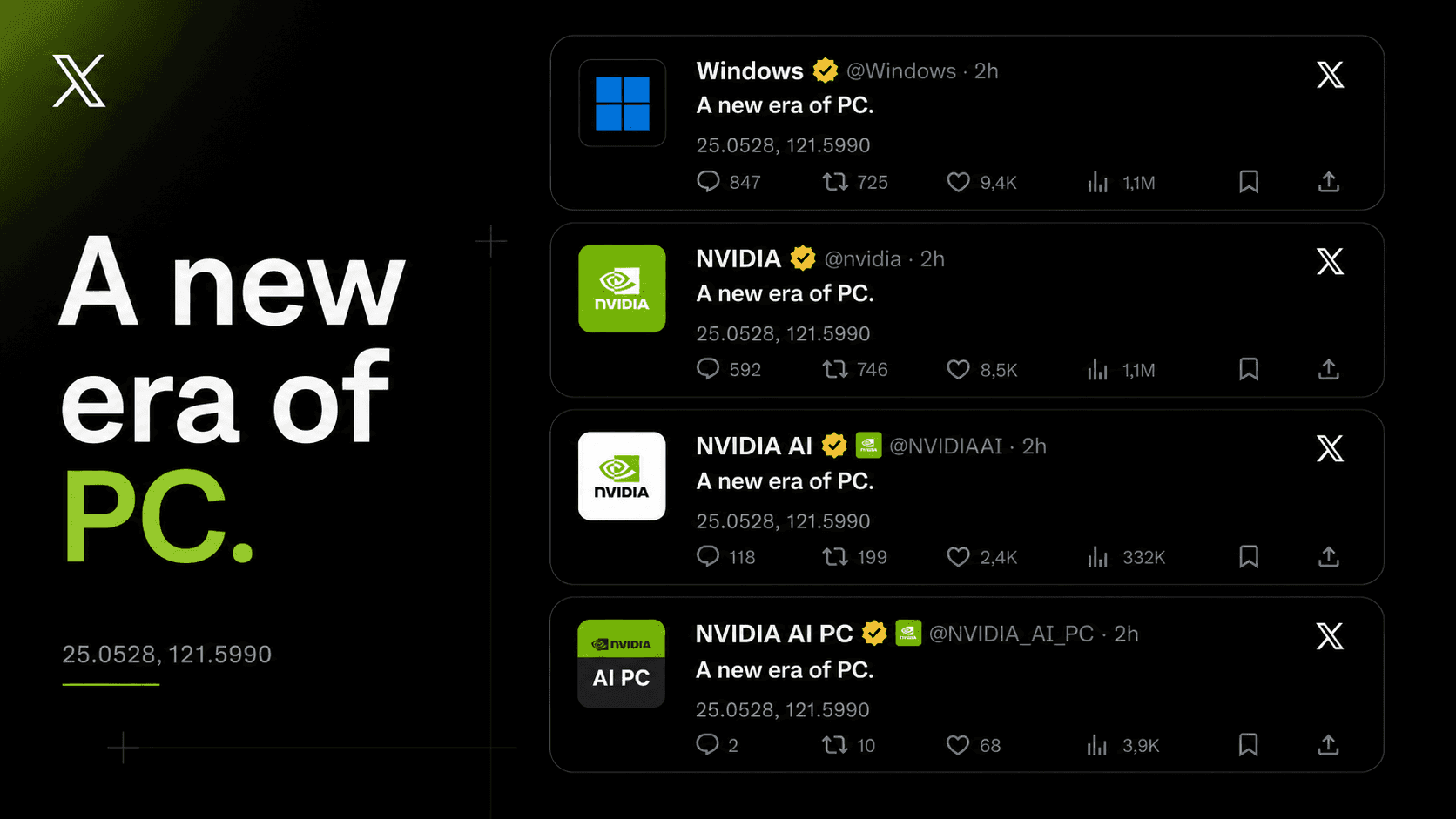
A New Era of PC! Why Microsoft and NVIDIA Are Posting the Same Mysterious Message
Microsoft and NVIDIA have sparked speculation with their mysterious “A New Era of PC” posts featuring Taipei coordinates. Explore what this could mean for AI-powered Windows PCs, next-generation NVIDIA hardware, and the future of personal computing.

Elon Musk’s Terafab: $25B AI Chip Factory That Could Beat TSMC
Elon Musk’s $25B Terafab aims to produce 1 terawatt of AI computing power yearly and put 80% of its chips in space. Will it beat TSMC and change computing forever?

Is AI a Threat? The Big Tech Changes of the Last 48 Hours
The tech world never pauses. What has happened in just the last 48 hours could change the direction of the future. Let’s not even start with Claude AI again.